
The Second Edition
The Second Edition of the 7 October Parliamentary Commission Report remains committed to meticulously documenting the facts of what happened on the 7 October attacks. New interviews with survivors and official investigations by authorities have be used to strengthen the accuracy of the chronology and details of the attack. These updates are reflected throughout the Second Edition.
In addition to strengthening the report’s existing content, new exclusive testimony has been provided to the Commission. As well as further research conducted into the planning and execution of the attack.
The Planning
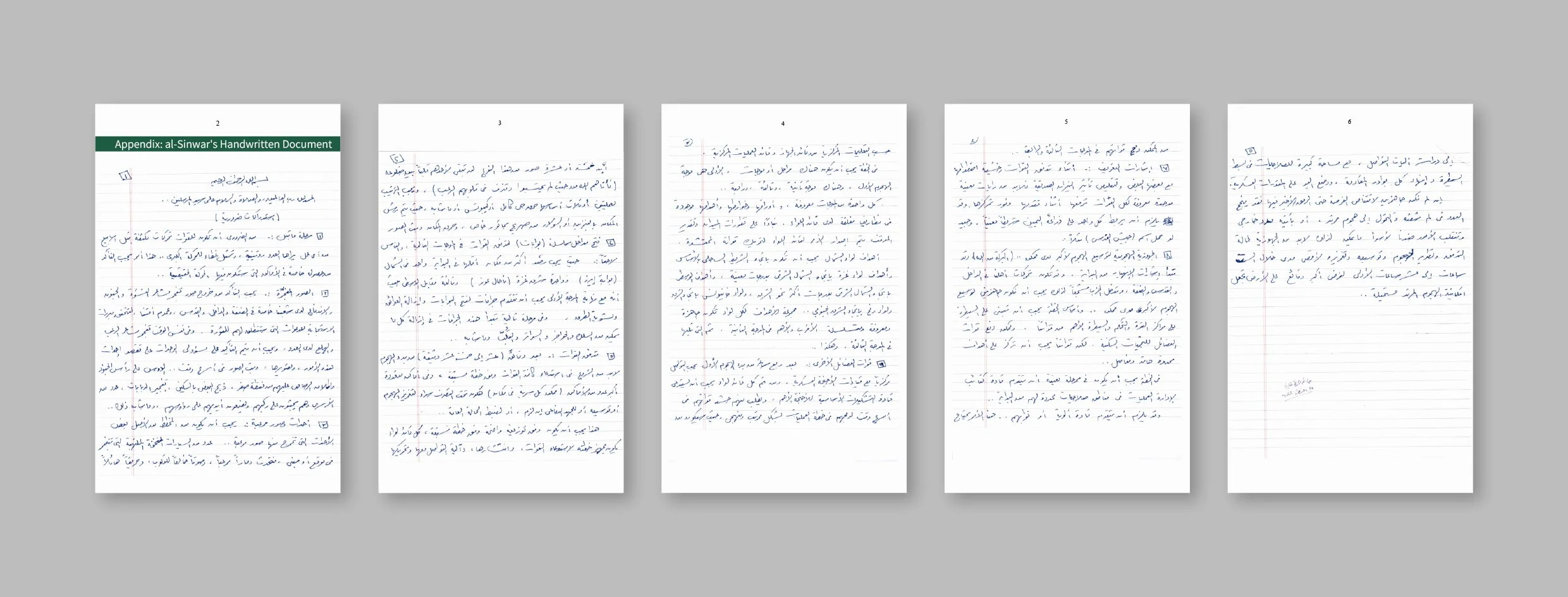
The report now includes a handwritten 6-page memo found inside a tunnel in Gaza, dated 24 August 2022, and attributed to Yahya Sinwar, former leader of Hamas in Gaza, which explicitly outlined the meticulous planning of the attack and instructions for the day itself – such as the psychological dimension of the attack through massacres that would be documented and broadcast in real time to instill terror among the Israeli public.
The memo plans how “each wave [would be] predetermined and has its own documents, maps and objectives sealed in envelopes held by the brigade commander.” Sinwar wrote that the attack must be filmed and broadcast live - as they did with gopros and body cameras. “It must be emphasised to the unit commanders that these things are to be carried out deliberately. That is, to document and broadcast the images as quickly as possible: stepping on the heads of soldiers, point-blank shootings, slaughtering people with knives, blowing up tanks, prisoners kneeling with their hands on their heads, and the like.”
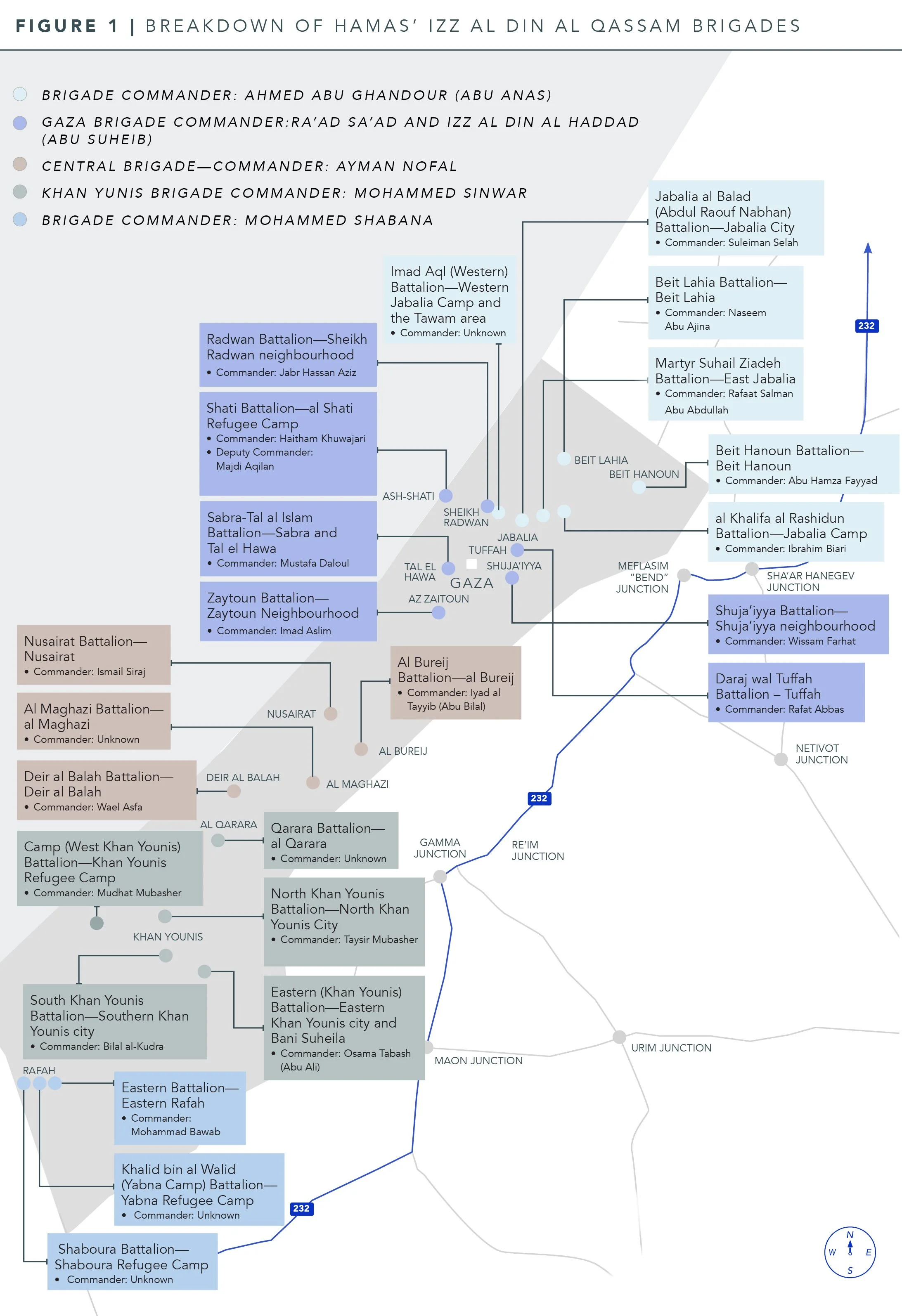
To better understand the level of organisation, and scale of the assault, the Second Edition includes a breakdown of the Hamas brigades (before the 7 October attacks). Hamas operates as a structured military force rather than a covert network of decentralized cells, such as other terror organisations. Its leadership designed the al-Qassam Brigades to function as a robust military organization, complete with formal unit levels and command hierarchies. This structure was designed to ensure continuity even if leaders are lost or parts of units are destroyed. The Brigades are organized into tiers ranging from squads up to full brigades, mirroring the organization of conventional armed forces.
Before the 7 October attacks, the brigades themselves were largely sectioned by their location within the Gaza Strip, consisting of the North Brigade (Brigade Commander: Ahmed Abu Ghandour (Abu Anas) and deputy commander: Wael Rajab), Gaza Brigade (Brigade Commander: Izz al Din al Haddad (Abu Suheib), Central Brigade (Brigade Commander: Ayman Nofal), Khan Yunis Brigade (Brigade Commander: Mohammed Sinwar) and Rafah Brigade (Brigade Commander: Mohammed Shabana), each with their own set of battalions and commanders. Within each of these brigades there are elite Nukhba commandos, which received Iranian training; the most sophisticated operational aspects of 7 October were undertaken by the Nukbha units. The Nukbha were established by Ra’ad Sa’ad.
The Attack
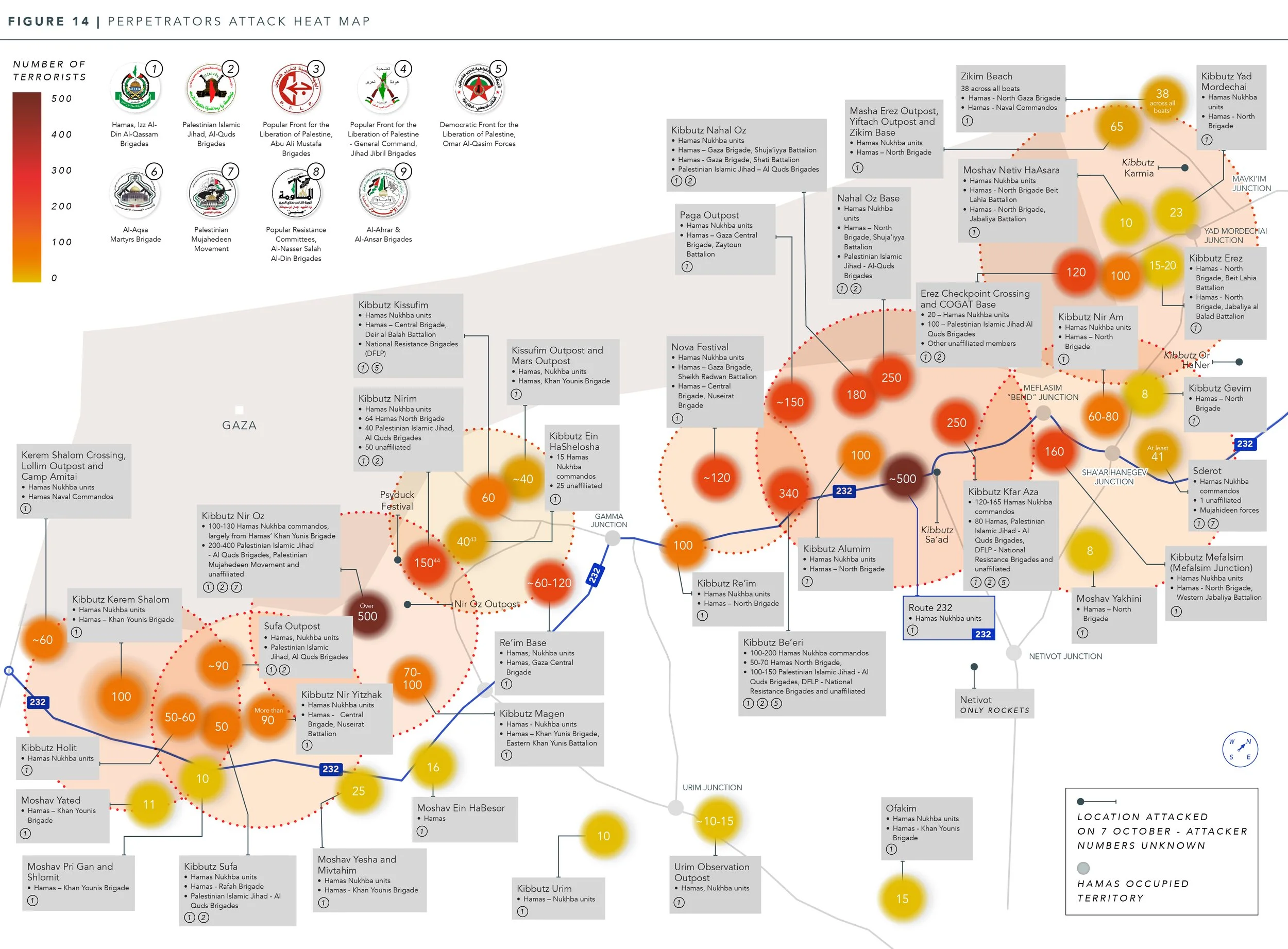
Intelligence and operational evidence show that nine factions coordinated through the “Joint Room for Palestinian Resistance Factions,” including the Izz Al-Din Qassam Brigades, Al-Quds Brigades, Abu Ali Mustafa Brigades, Jihad Jibril Brigades, National Resistance Brigades, Nasser Saleh Al-Din Battalions, Al-Aqsa Martyrs’ Brigades, Holy Warriors’ Battalions, and Al-Ansar Brigades. Approximately 7,000 individuals took part in the attack—3,800 from Hamas and 2,200 from allied groups and civilians who crossed the border—while an additional 1,000 operatives remained in Gaza to provide operational support and launch rocket and drone attacks during the assault. The Second Edition includes a heat map which illustrates the estimated size of the forces that attacked and infiltrated each location, and, where known, identifies which terror groups were involved. There is significantly less verified information regarding the numbers involved in assaults on Israeli military bases and outposts, as formal IDF investigative probes into these incidents have not yet been conducted. These figures largely exclude smaller terror group involvement and the thousands of Palestinian civilians who also crossed the border, meaning totals may not add up precisely but reflect the best available verified reports and estimates.
Perpetrators Attack Heat Map
Testimonies
The Second Edition incorporates 12 firsthand hostage testimonies into the report to deepen and strengthen understanding of how individuals were taken during the attacks. The report has also added further testimony from survivors of the attack, whose experiences help chronicle the events of the day.
The below summaries are from those with British links. For full details and references, download the full text of the report.
Emily Damari
Emily Damari, a British-Israeli citizen, was taken hostage from her home in Kibbutz Kfar Aza. She was released in a ceasefire deal on 19 January 2025 after 471 days in captivity. Following her return, further details about how she was taken hostage, emerged. The scope of the report remains solely about the 7 October attacks, so the details of her captivity have not been included.
Emily was abducted from her home on the morning of the attack, after waking at 06:30 to unusually intense rocket fire and gunshots. Feeling afraid, she messaged her friend Gali Berman at 07:00 asking him to come stay with her in her safe room. As they followed alarming updates and heard Arabic being spoken outside, Emily described the situation as frightening and chaotic. They remained hidden for about four hours with her dog, until attackers broke in around 10:30. As they entered, Emily warned, “Gali, they’re here.” During the attack, her dog was shot, killing it, and the bullet wounded her leg. She was then taken from her home at 10:33.
Outside, she saw dozens of attackers “ecstatic” and celebrating. When they threatened Gali, Emily pleaded, “No — kill me instead.” Despite her injuries, one attacker responded, “No, lady. I take you to hospital.” Realising she was being taken alive, Emily again begged them to kill her, but they refused. Reflecting on the scene, she later described her community as “hell, there was fire all around, doors open, everyone dead.”
At around 10:45–11:00, witnesses saw Emily’s car being driven by a terrorist out of the kibbutz toward Gaza, with Emily and the Berman twins inside. During the journey, Gali and Ziv were blindfolded, and Emily tried to comfort them by saying, “Gali, Ziv is with us. Ziv, Gali is with us.” Emily was taken to Shifa Hospital in Gaza, where she briefly encountered another injured hostage. She later recalled a surgeon introducing himself as “Dr Hamas” before she was put under anesthetic. When she woke, she was told the operation was complete and that two of her fingers had been amputated. After her release, she required multiple corrective surgeries.
The Sharabi Family
Eli Sharabi, 51, was taken hostage from Kibbutz Be’eri on 7 October and later released as part of a ceasefire deal on 8 February 2025 after 491 days in captivity. His brother, Yossi Sharabi, 53, who was abducted in a separate incident from the same kibbutz, was killed in captivity, with his body returned to Israel on 14 October 2025. Eli’s wife, Lianne, 48, and their daughters, Noiya, 16, and Yahel, 13, were killed during the attack on their home - all three were British-Israeli citizens.
Earlier that day, Lianne had messaged family members warning, “Nira, I can hear them. They are here at our house. They are shooting and shouting: ‘Die Israel’. Please call for help.” When the attackers broke in, Eli and Lianne chose not to resist, hoping to protect their daughters. As gunfire erupted, they threw themselves over the girls, pleading for the attackers to stop. Eli was separated from his family as they were taken into another room, unable to see what was happening. He later recalled telling Lianne not to be afraid, but described the moment as “fear beyond anything I’ve ever felt.”
As Eli was dragged away, he called out to his children, “I will be back.” Reflecting later, he said, “I had to believe that. But that was the last time I ever saw them. I didn’t know I should have said goodbye, forever.” He described seeing large numbers of attackers celebrating in the kibbutz, and recalled, “They dragged me to the door, to the border, beating me the whole way.” Upon arrival in Gaza, he was attacked by a crowd before being taken into a mosque, where he said, “I was their trophy.” Eli was moved between multiple locations, restrained, blindfolded, and held in harsh conditions alongside another hostage, as captors deliberately transferred them between sites to avoid detection.
In a separate incident in Be’eri, Yossi Sharabi was also taken hostage when attackers entered his home at around 12:30, holding the family at gunpoint, seizing their phones, and vandalising property. One family member later recalled how the attackers tore down an Israeli flag, shouting, “Down with Israel! This is Palestine! This is not Israel! Israel does not exist! Kill all the Jews!” Yossi was taken to Gaza along with others, while his wife Nira, daughters, and additional hostages were left behind. After the attackers fled under gunfire, they were later rescued by Israeli forces that evening.
Anat Ron-Kendall
British-Israeli citizen Anat Ron-Kendall, 55, a long-term UK resident, survived the 7 October attack at Kibbutz Nahal Oz alongside her son, Jordan Kendall, 20. They had travelled to Israel to support her father, Shlomo Ron, 84, a co-founder of the kibbutz, ahead of scheduled surgery. In the early morning, as rocket sirens began, Anat, her sister, and her son entered the safe room in the annex of the family home. She later described the intensity of the attack as “deafening.” Initially unaware of the scale of the attack, they soon learned of a terrorist infiltration and were instructed to remain inside.
As the situation escalated, Anat grew increasingly fearful—particularly because the safe room door would not lock. At around 10:00, believing they might not survive, she called her husband in the UK and asked him to tell their children she loved them. Between approximately 10:20 and 10:35, attackers reached the house. Gunfire and shouting in Arabic intensified as shots were fired into the home. Shlomo Ron, who had remained in the living room, was fatally shot through a window. Shortly after, Anat’s sister received a message from the family’s carer confirming, “they shot Aba [father].”
Anat, her sister, and her son remained hidden in the safe room for around 12 hours, sitting silently by the door as continuous gunfire, rockets, and shouting echoed outside. Terrified to move or make noise, they endured extreme fear, while in another part of the house the attackers attempted to access the other safe room.
At 18:30, Israeli forces reached the house and evacuated them. Upon exiting, Anat’s son asked, “Where is Saba?” and was told, “Saba is dead,” before they had seen his body. They were then moved between houses under continued fire before being evacuated from the kibbutz later that night.